The CFS 53rd Plenary Session endorsed the Policy Recommendations on Strengthening Urban and Peri-urban Food Systems to Achieve Food Security and Nutrition in the context of Urbanization and Rural Transformation.Throughout the year, the process included meetings of the CFS Open-Ended Working Group, two rounds of negotiations and extensive consultations on the draft policy document involving several CFS actors.
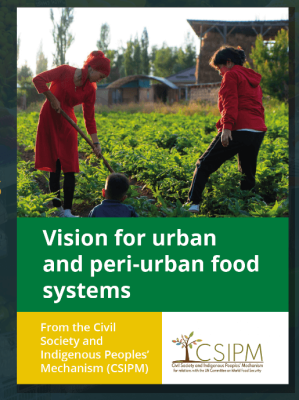
The CSIPM Working Group on Urban and Peri-Urban Food Systems facilitated the active participation of civil society and Indigenous Peoples organisations in this process. The Working Group also produced a Vision Document that brings together a compilation of case studies and experiences from around the world, showing how communities are driving concrete actions toward food systems that respond to the realities and needs of urban and peri-urban populations.
During the negotiations, the CSIPM expressed concern about setbacks in the recognition of the rights of Indigenous Peoples to self-determination and free, prior and informed consent. For this reason, the CISPM called on the CFS through an explanatory note to respect the autonomy of Indigenous Peoples, as established by international law and, in particular, the United Nations Declaration on the Rights of Indigenous Peoples (UNDRIP).
At the CFS 53, the statement on behalf of the CSIPM was delivered by Coordination Committee members Samuel Ikua (Kenya/Habitat International Coalition) and Ximena Moreno (Brasil/URGENCI).
Statement delivered by Samuel Ikua (Kenya/HIC) and Ximena Moreno (Brazil/URGENCI) on 22 October, 2025 during the endorsement of the CFS Policy Recommendations on Strengthening Urban and Peri-urban Food Systems.
My name is Samuel Ikua from Habitat International Coalition. I come from Kenya where I coordinate agroecological training of urban farmers in Nairobi city.
This intervention will be delivered by me and my colleague Ximena Moreno, my co-coordinator of the CSIPM urban and peri-urban food systems working group that followed this policy workstream.
We want to thank the Rapporteur of this workstream, Dr. Balaji, the Permanent Representative of India for conducting an inclusive and transparent process to arrive at these draft policy recommendations.
As CSIPM, we support the endorsement of the CFS Recommendations on Strengthening urban and peri-urban food systems policy, because the document highlights some of the key priorities of the CSIPM, which include equitable land tenure rights, territorial markets and smallholder farmers agency. As rights holders , we know and we experience the importance of local governments. Working with them is key for us and their involvement is important in every step of the process, from policy discussion, to formulation but also implementation, as well as monitoring, evaluation and accountability.
Local governments as organs of the treaty-bound member states bear common but differentiated obligations to respect, protect and fulfil the human right to food. National governments should provide local authorities with adequate resources to implement their obligations on the human right to food.
This will enhance the capacity of local governments to implement peasant agroecology programmes, build infrastructure for territorial markets, school meals programmes, and other food security social protection programmes such as community kitchens.
This workstream has presented a compelling case and strategic opportunity to include local governments in global food security policy processes in the CFS. Building on this workstream, local governments participation in CFS should be strengthened in upcoming workstreams.
I now give the floor to Ximena Moreno.
Buenos días, mi nombre es Ximena Moreno y soy de Urgenci. Vengo de Brasil. Actualmente participo en el Comité de Coordinación del Mecanismo de la Sociedad Civil y de los Pueblos Indígenas, facilitando la participación del sector de consumidores.
Quería compartir con ustedes nuestra preocupación por el hecho de que las desigualdades presentes en los sistemas alimentarios urbanos y periurbanos afectan más fuertemente a las mujeres, los migrantes, las personas con movilidad reducida y los grupos racializados.
En esta estructura desigual, las mujeres son las más afectadas por la inseguridad alimentaria y nutricional, como lo reitera el Informe del estado de la seguridad alimentaria y la nutrición en el mundo de este año. No se puede negar que esta situación empeorará con el cambio climático, ya que tendremos cientos de personas migrando de las zonas rurales más afectadas a las zonas urbanas periféricas.
Para ayudar a estas personas, no podemos depender de la privatización o de las asociaciones público-privadas que desmantelan por completo los servicios públicos y agravan las dificultades de los más necesitados. También queremos destacar que es esencial que la agroecología se destaque en estas y otras recomendaciones, ya que es una forma de cultivo que promueve el desarrollo sostenible, saludable y solidario que necesitamos.
El Mecanismo celebra estas recomendaciones políticas, sin embargo nos gustaría recalcar que son inaceptables los retrocesos en los derechos de los Pueblos Indígenas, en especial a lo que se refiere a sus derechos inherentes a la libre determinación y al consentimiento libre, previo e informado.
Queremos recordarles que ya existen diversos instrumentos internacionales. Para citar un ejemplo, en el reporte de este año, el relator especial de los Pueblos Indígenas, Sr. Alberto Barume (Resolución A/HRC/60/29) menciona los peligros de la fusión de las terminologías de Pueblos indígenas junto con otros actores. Así que solicitamos que en futuros documentos se mantenga la autonomía ya reconocida en el derecho internacional, principalmente la Declaración de las Naciones Unidas sobre los Derechos de los Pueblos Indígenas (UNDRIP).
Por este motivo, pedimos que la posición del Mecanismo de la Sociedad Civil y de los Pueblos Indígenas quede registrada en el informe final de esta Plenaria.
Durante este proceso el Mecanismo elaboró un documento de visión con ejemplos de experiencias que contribuyen a los sistemas alimentarios urbanos y periurbanos sostenibles, resilientes, saludables y solidarios.
Muchas gracias.
The Vision Document contains the policy priorities identified by CSIPM participant organisations and a compilation of case studies that showcase how communities are leading food systems transformation from the ground up. The document was also a key tool to guide the Working Group during the policy negotiations.
“The case studies throughout the vision document showcase the innovations that communities are already implementing on the ground. They serve as evidence of transformations occurring based on our policy priorities and should be recognized as such.”
The CSIPM launched the Vision Document in the context of the CFS 53 that is taking place from 20-24 October, 2025, at FAO Headquarters.