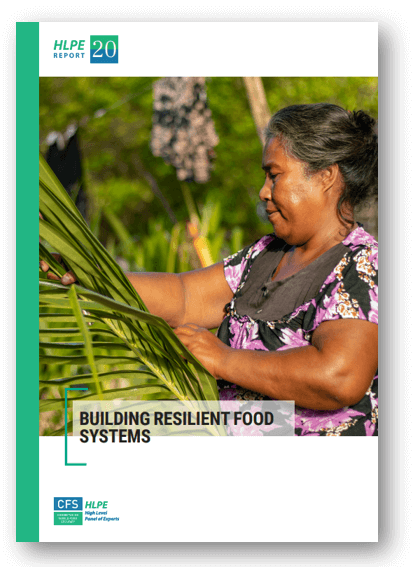
The 53rd Plenary Session of the UN Committee on World Food Security (CFS 53) marked the launch of the CFS policy convergence process on Building Resilient Food Systems, which will unfold throughout 2026. This workstream seeks to develop a new set of policy recommendations to guide governments in designing and implementing measures that strengthen the resilience of food systems in the face of multiple, intersecting crises. During the CFS 53, the High Level Panel of Experts on Food Security and Nutrition (HLPE-FSN) presented its report Building Resilient Food Systems, providing a foundation for the upcoming policy process.
Coordination Committee member Robert Arcidiacono (Australia/ Australian Food Sovereignty Alliance) delivered the following statement during Plenary.
Watch the CFS 53 Recording of the Session
Statement delivered by Robert Arcidiacono (Australia/AFSA) during the session on Building resilient food systems for food security and nutrition at the CFS 53rd Plenary Session on 22 October, 2025.
Good Morning. Thank you, Chair, for allowing me to share the CSIPM’s reflection on the HLPE report on Building Resilient Food Systems and priorities from CSIPM ahead of the policy convergence process. My name is Robert Arcidiacono, I am the focal point for the Australasian Region within the CSIPM. Before I commence, I would like to acknowledge the traditional owners, the Turrabul and Yaggera People of the lands on which I come, and pay my respect to their ancestors past, present and emerging. This CFS workstream is of critical importance to CSIPM, as the voices of the constituents in this mechanism, those who practice care for land and waterways, rooted in food sovereignty, and social and solidarity economies, are integral to feeding the world and ensuring ‘resilient food systems’. We also reinforce the comments from the drafting team leader earlier today, Alison Blay-Palmer, on this work stream being dedicated to people on the ground, and CSIPM hopes these voices can be prioritised in the upcoming work stream.
We welcome this report and congratulate the project team for its excellent work. As the report highlights, it is vital to move beyond ‘bouncing back,’ which risks maintaining the status quo. We welcome the report’s focus on ‘equitably transformative resilience,’ and understand it to mean that, we need to instead, ‘bounce forward’ while centering equity and justice. It recognises that vulnerability stems from structural inequalities and promotes a systemic approach connecting food, environment, health, and social protection. These interconnections cannot be understood without acknowledging that transformation is inherently political and requires tackling power imbalances. We therefore require deliberate political choices, strong public regulation, and forms of solidarity that challenge accumulation and domination.
The SOFI report highlights how the dominant food system approaches are failing people and the planet. The COVID-19 pandemic also exposed the fragility of this dominant system, where globalised supply chains were demonstrated to be only as strong as the weakest link. As one link in the chain fails, the whole thing falls apart. In contrast, the resilience of diversified, locally-based agroecological food systems, those built on ‘food webs’ of farmers and communities, adapted, and in many cases, thrived. Smallholder farmers, Indigenous Peoples and community networks pivoted rapidly, maintaining food access and protecting livelihoods through community solidarity and shorter supply chains. These localised food systems demonstrate that resilience is built through ecological, social and territorial foundations, and the agency of the smallholder farmers, pastoralists, fisherfolk, Indigenous Peoples, agricultural and food workers, the landless, women, and youth, who produce the majority of the world’s food.
As noted in the report, resilient food systems must be centred in agroecology. Agroecology, food sovereignty and solidarity economies, redistribute power, and build resilience from below. They embody reciprocity, care, and collective governance, centring small-scale producers, Indigenous peoples, women and youth as agents of transformation. We must also recognise that women carry the main load of unpaid care work: approaches to resilience must address these gender imbalances. Unlike top-down, market-driven approaches, agroecology redefines resilience not as adaptation to crisis but as emancipation from systemic dependence, advancing ecological justice, gender equality, and food democracy as the foundation of sustainable, people-centred transformation.
So, what does this mean for tangible, implementable policy actions to support resilient food systems? To build resilience, we need to stop looking for magical technological fixes, rather start addressing structural changes within the food system. We need technology, of course, but it has to serve people and communities first. We need to address financial institutions’ dominance, and Global South debt dependency, the use of food as a weapon of war, and the appropriation and commodification of the commons – land, water, seeds, labour, and knowledge.
In conclusion, building resilient food systems means rejecting the illusion of a return to “normal” because normality is precisely what brought us here. It is about bouncing forward, towards transformative solutions, with rights and equity at the centre of public policies. Only then can resilience truly liberate peoples, protect the planet, and guarantee the right to food for all.